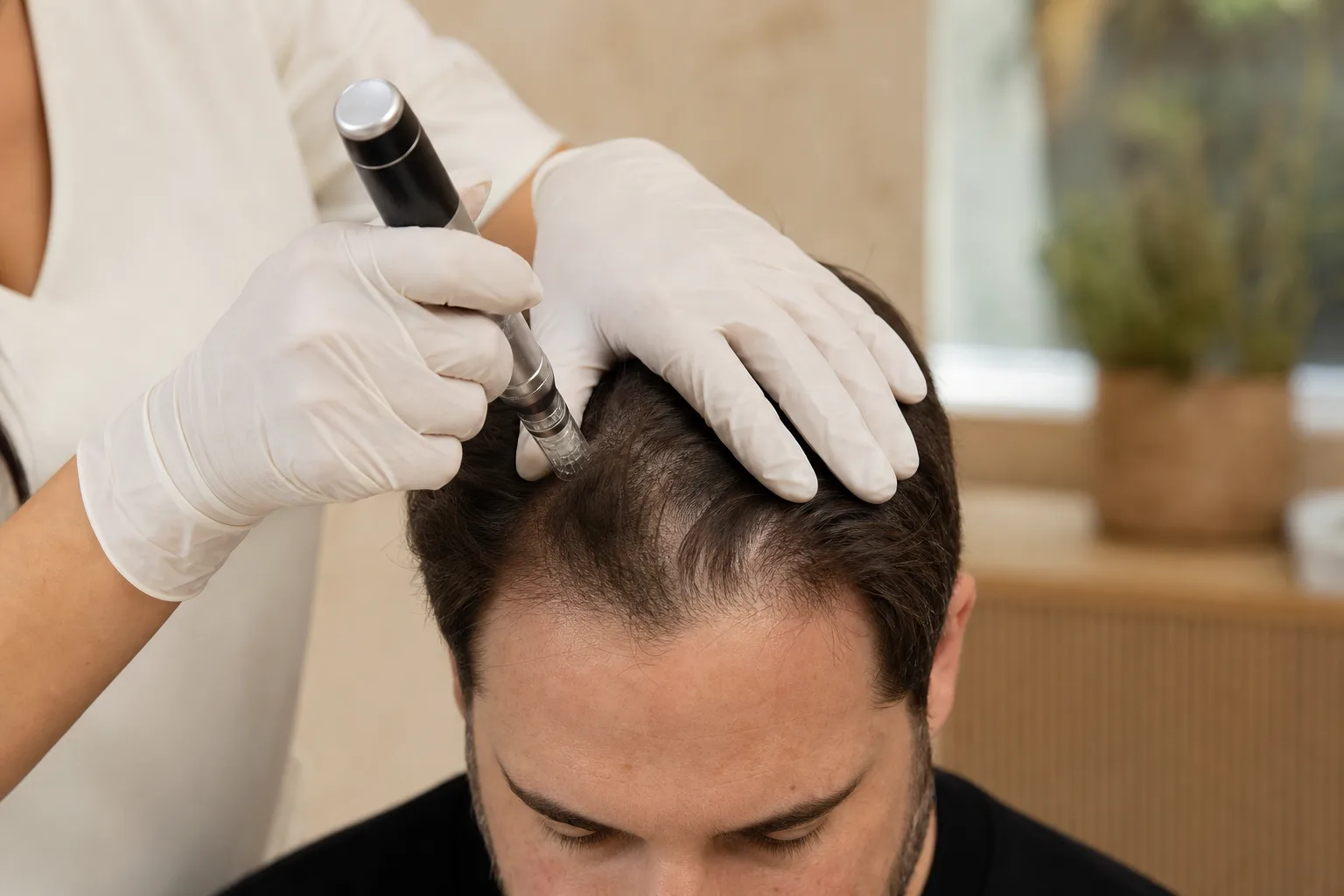
Hair Microneedling for Men in Orange County
A receding hairline or a thinning crown, treated while the follicles are still active. No surgery, no daily bottle, nothing to explain afterward. From $240.
Quick answers
- Scalp microneedling combined with 5% minoxidil ranked first of six regimens for hair-density improvement at 24 weeks in a network meta-analysis of 27 trials and 1,110 patients, with a SUCRA score of 95.8% [2].
- A 2024 randomized trial using microneedling at 0.6 mm every four weeks found hair density rose 95.6 hairs per cm² against 52.4 on minoxidil alone, significantly ahead from week 4 onward [3].
- At UR ALLURE the serum is worked into open micro-channels on the surface of the scalp and is never injected — the serious exosome complications reported in the literature occurred where exosomes were injected rather than micro-needled [6].
- Pattern hair loss is a non-scarring alopecia: the follicular unit and the follicular openings are preserved, which is why it is considered at least partially reversible [8].
- There were no serious adverse events across 536 subjects treated with microneedling for androgenetic alopecia in the largest systematic review of the technique [5].
- Scalp microneedling at UR ALLURE in Mission Viejo is $240 for hairline and temples, $280 for the crown and $400 for the full scalp.
What Scalp Microneedling Is
A fine-needle device makes hundreds of controlled micro-punctures across the thinning area of the scalp, and an exosome serum is worked into those channels while they are still open. The needles run 0.5 to 1.5 mm, deep enough to reach the dermal papilla layer where the follicle is fed. The serum is worked in, never injected — nothing is syringed under the skin, and that detail matters more than it sounds. The scalp is built to keep things out, which is why even topical minoxidil absorbs poorly through intact skin [2]; the micro-channels are what give a topical a way past the barrier.
Why Men Do This, and Why Sooner Beats Later
Male pattern hair loss is thought to affect 80% of men by the age of 80 [8], so the question is rarely whether but how far. What makes timing the whole argument is structural. Pattern loss is a non-scarring alopecia: the follicular unit stays in place and the follicular openings are preserved, which is why it is considered at least partially reversible [8]. The follicles are shrinking, not gone. Every treatment for this works on hair you still have, which is why the honest advice is to start while the pattern is early.
A follicle that has gone quiet can be worked with. One that is gone cannot.
What You Are Actually Choosing Between
Most men arrive weighing three things: a daily topical, surgery, or nothing. The topical has the weakest real-world record of the three. Among 400 consecutive patients prescribed topical minoxidil, 86.3% discontinued it, 63.8% reported no efficacy or worsening, and only 12.0% used it beyond a year [7]. It rewards persistence — improvement reached 43.8% among those still using it past twelve months [7] — so most people quit before it could have worked. Surgery is the other end: hair transplantation results in permanent hair restoration, though cost and access can be major barriers [8]. This sits between them.
The Follicle Biology That Decides Whether This Works
Androgen activity at the follicle shortens the growth phase, cycle after cycle. Thick, pigmented terminal hairs are progressively converted into fine vellus hairs, and together with a truncated growth cycle that is what reduces density [8]. Follicle count does not fall; shaft caliber does. Depth is the other half of the biology, and it runs opposite to intuition: the stem-cell bulge you want to stimulate rather than damage sits 1.00 to 1.80 mm below the surface, and puncture depths around 0.60 mm already recruit stem cells and growth factors without reaching it [5]. Deeper is not braver.
What the Evidence Shows
Scalp microneedling has more published trial evidence behind it than most things sold for thinning hair. Combined with 5% minoxidil it ranked first of six regimens for hair-density improvement at 24 weeks in a Bayesian network meta-analysis of 27 trials and 1,110 patients — a SUCRA score of 95.8%, where 100% would mean best in every comparison — beating minoxidil alone by 13.01 hairs per cm² [2]. Pooled across 12 randomized trials and 631 patients it significantly improved hair count (SMD 1.32, 95% CI 0.73–1.92) and hair diameter (SMD 0.34, I² = 0%) [4].
- The founding randomized trial, 100 men over 12 weeks: a mean gain of 91.4 hairs per cm² against 22.2 on minoxidil alone, and 82% reporting more than 50% improvement versus 4.5% of controls [1].
- A 2024 randomized trial, 36 men treated at 0.6 mm every four weeks: density rose 95.6 hairs per cm² against 52.4 (p < 0.001), diameter 18 µm against 6 µm (p = 0.004) [3].
- Investigators rated the combination improved about five times more often than minoxidil alone (OR 5.01), and the men scoring their own scalps agreed (OR 5.13) [4].
In that founding trial, 20 men had already failed six to twelve months of finasteride and minoxidil. Those randomized to microneedling improved; the ones left on minoxidil alone showed no change over 12 weeks [1].
This Is Not a Men-Only Treatment
The service is written up for men because that is who searches for it, but women make up a substantial share of the evidence and the results are good. Of the 1,127 subjects in the largest systematic review of microneedling for hair loss, 269 were women, and the review concluded that as an adjunct therapy microneedling improved hair parameters across genders and a range of hair-loss types [5]. In one all-female study of women whose hair counts had plateaued for at least six months on existing treatment, 11 of 11 improved by at least 1 to 1.5 Sinclair grades [5].
The Appointment, Step by Step
Plan on forty-five to sixty minutes and drive yourself home afterward. Numbing cream goes on first — the 2024 trial used a 2.5% lidocaine and 2.5% prilocaine cream left in place for 15 to 45 minutes before treating [3], which is the approach here. The pass stops at mild redness or pinpoint bleeding, the endpoint used in the randomized trials rather than a sign something went wrong [3].
- Consultation, about 10 minutes — your pattern of loss is assessed and the areas worth treating are agreed.
- Preparation, about 10 minutes — the scalp is cleansed, numbing cream applied and left to work.
- Treatment — the pass runs across the targeted zone, then the exosome serum goes straight into the open channels.
Safety, and Why Nothing Is Injected
The safety record in the hair-loss literature is good: no serious adverse events across 536 subjects receiving microneedling for androgenetic alopecia, with transient pain, scalp irritation and mild redness the most common mild effects and withdrawal rates comparable to the non-microneedling groups [5]. Adding microneedling did not make scalp itching worse — it was slightly less common than on the drug alone (RR 0.74, 95% CI 0.42–1.33) [4]. And the serious complications reported anywhere in the exosome literature — delayed granulomas, post-inflammatory hyperpigmentation, anaphylaxis — occurred where exosomes were injected rather than micro-needled [6]. Here they are worked into the surface.
- Deferred for now: an active skin infection or cold sore, a clotting or bleeding disorder or anticoagulant therapy, uncontrolled diabetes, immunosuppression, keloid scarring, recent tanning, pregnancy or breastfeeding, or current isotretinoin.
- Sudden or patchy loss, or loss with intense itching, burning, tenderness, scaling or pus, is a different problem from pattern hair loss and is diagnosed rather than treated cosmetically.
Downtime and Aftercare
Mild redness and tenderness for a day, then normal activity. Leave the scalp unwashed for 24 hours and put nothing on it in that window that was not applied in the room — in the trial protocols even minoxidil, the drug the procedure exists to deliver, was withheld for a full 24 hours after every session [1][3]. A few days of light flaking is the skin healing, not dandruff. Daily sunscreen on exposed scalp is the one standing instruction. No bandage, no shaved patch, nothing anyone else has to have explained to them.
The Results Timeline
Hair runs on a months-long cycle and no treatment beats that clock. In the founding trial, faster growth in existing hair showed at week 1 and new growth was noticeable at around 6 weeks, against about 10 weeks on minoxidil alone [1]. In the 2024 trial, density was significantly ahead of the control arm from week 4 and diameter from week 8 [3]. Measured density gains land at 12 weeks, and 24 weeks is the common endpoint across the literature [1][2]. Reduced shedding usually comes first, then thicker shafts, then new growth.
Photograph your scalp in the same light before session one. At month three it is the only comparison worth anything.
Sessions, Maintenance, and What It Costs
Plan four to six sessions about four weeks apart, then quarterly maintenance. Monthly is what the 2024 randomized trial used, chosen because treating every four weeks improved how many subjects completed the course [3]. Published courses have run from 3 to 52 sessions, averaging 9.53 per study over roughly 20 weeks [5], and trials running longer than 12 weeks were not significantly better than shorter ones (p = 0.20) [4]. Pattern hair loss keeps progressing, so gains need upkeep; that is maintenance, not failure. Pricing is by area, because a receding hairline and a whole thinning scalp are not the same amount of time or product.
- Scalp microneedling — hairline and temples $240, crown $280, full scalp $400.
- Purasomes Hair & Scalp Exosomes, a complex formulated specifically for the scalp — hairline and temples $350, crown $400, full scalp $550.
- Course of four full-scalp Purasomes sessions, three to four weeks apart — $1,870 instead of $2,200.
Frequently asked questions
Does scalp microneedling work?
Yes. Combined with 5% minoxidil it ranked first of six regimens for hair-density improvement at 24 weeks in a network meta-analysis of 27 trials and 1,110 patients, SUCRA 95.8% [2]. Pooled across 12 randomized trials it improved hair count over minoxidil alone (SMD 1.32) [4]. With exosomes in the channels, the alopecia study in the 2026 review gained 8.11 hairs per cm² over 24 weeks (p < 0.001) [6].
Can scalp microneedling regrow your hair?
Only where a living follicle is still there, which in pattern hair loss is usually the case. Pattern loss is non-scarring: the follicular unit and the follicular openings are preserved, which is why it is considered at least partially reversible [8]. A miniaturized follicle is shrunken, not destroyed. Skin that looks smooth and shiny with no visible follicular openings is a different condition, and the facial microneedling service remains available as a separate skin treatment.
How much does scalp microneedling cost?
$240 for hairline and temples, $280 for the crown and $400 for the full scalp at UR ALLURE in Mission Viejo. The Purasomes tier, which uses a complex formulated for the scalp, is $350, $400 and $550 for the same areas, with a course of four full-scalp sessions at $1,870 instead of $2,200. Pricing is by area.
How often microneedling for hair loss?
Four to six sessions about four weeks apart, then quarterly maintenance. Monthly is the interval the 2024 randomized trial used, chosen because treating every four weeks improved how many subjects finished the course [3]. Published courses have run from 3 to 52 sessions, averaging 9.53 per study over about 20 weeks [5], and trials longer than 12 weeks were not significantly better than shorter ones (p = 0.20) [4].
Does scalp microneedling hurt?
Less than most men expect, and numbing cream goes on first — the 2024 trial used a 2.5% lidocaine and 2.5% prilocaine cream left in place for 15 to 45 minutes [3], which is the approach used here. Pain scales with depth: in the head-to-head comparison inside the largest systematic review, more pain was reported at 1.2 mm than at 0.6 mm [5]. Pinpoint bleeding during the pass is the endpoint, not trouble [3].
Is microneedling for hair permanent?
No, because pattern hair loss keeps progressing whatever you do about it — which makes this maintenance rather than a one-time fix. The longest look on record comes from the founding trial: eight months after it ended, all of the men in the microneedling group reported a sustained response [1]. That is why the plan is four to six sessions and then quarterly upkeep.
Is scalp microneedling worth it?
Worth it where there is still hair to work with, and a poor bet on a bare scalp. Weigh it against what most men are actually holding: a daily topical that 86.3% of users discontinue and 63.8% report no benefit or worsening from [7]. Against that, this ranked first of six regimens across 1,110 patients [2], and investigators rated it improved about five times more often than minoxidil alone (OR 5.01) [4].
What depth for scalp microneedling?
Between 0.5 and 1.5 mm here, and the ceiling is deliberate. The stem-cell bulge sits 1.00 to 1.80 mm below the surface, and 0.60 mm already recruits stem cells and growth factors without reaching it [5]. In the one head-to-head trial, 0.60 mm raised both hair count and diameter while 1.20 mm raised count only [5]; a pooled comparison of depths above and below 1 mm found no significant difference (p = 0.85) [4].
Can you do scalp microneedling at home?
You can buy a device, but the physics is against you. A manual roller penetrates only 50 to 70% of its stated needle length, so the number on the box is not the depth you get [5], and the bulge you are trying not to damage sits 1.00 to 1.80 mm down [5]. The trials people quote ran with the scalp shaved and prepared with betadine and normal saline before every session [1].
Does microneedling scalp cause shedding?
No — it does not cause hair loss. The largest systematic review found no serious adverse events across 536 subjects treated for androgenetic alopecia, with withdrawal rates comparable to controls [5]. A brief rise in shedding early on is a different thing entirely: resting hairs are released as new ones come through, which is documented with minoxidil, where 9.8% of 400 patients saw it and it settled as treatment continued [7].
Is scalp microneedling safe?
The record is good: no serious adverse events across 536 subjects receiving microneedling for androgenetic alopecia, with transient pain and mild redness the common effects [5]. Adding microneedling did not make scalp itching worse (RR 0.74, 95% CI 0.42–1.33) [4]. Across the eight studies in the 2026 exosome review no patient discontinued for an adverse effect, and the serious complications reported occurred where exosomes were injected rather than micro-needled [6].
When can I wash my hair after microneedling?
After 24 hours. Until then nothing goes on the treated scalp that was not applied in the room — in the trial protocols even minoxidil, the drug the procedure exists to deliver, was withheld for a full 24 hours after each session [1][3]. After that, wash and style normally, with daily sunscreen on any exposed scalp.
Sources
- [1] Dhurat R, Sukesh M, Avhad G, Dandale A, Pal A, Pund P. “A Randomized Evaluator Blinded Study of Effect of Microneedling in Androgenetic Alopecia: A Pilot Study.” International Journal of Trichology, 5(1): 6–11 (2013). DOI: 10.4103/0974-7753.114700
- [2] Gupta AK, Wang T, Rapaport JA, et al.. “Relative Effects of Minoxidil 5%, Platelet-Rich Plasma, and Microneedling in Pattern Hair Loss: A Systematic Review and Network Meta-Analysis.” Skin Appendage Disorders, 9(6): 397–406 (2023). DOI: 10.1159/000534196
- [3] Adistri K, Sirait SP, Rihatmadja R, Legiawati L, Indriatmi W, Saldi SRF. “Effectiveness and safety of the combination therapy of micro-needling and minoxidil in androgenetic alopecia of Indonesian men: a randomized controlled trial.” Dermatology Reports, 16(3): 9945 (2024). DOI: 10.4081/dr.2024.9945
- [4] Ahmed KMA, et al.. “Evaluating the efficacy and safety of combined microneedling therapy versus topical Minoxidil in androgenetic alopecia: a systematic review and meta-analysis.” Archives of Dermatological Research, 317: 528 (2025). DOI: 10.1007/s00403-025-04032-1
- [5] English RS Jr, Ruiz S, DoAmaral P. “Microneedling and Its Use in Hair Loss Disorders: A Systematic Review.” Dermatology and Therapy, 12(1): 41–60 (2021). DOI: 10.1007/s13555-021-00653-2
- [6] Dhaliwal NK, Moothathamby T, Sokhal BS, Gkini M-A. “The Use of Microneedling With Exosomes in Dermatology: A Systematic Review.” Journal of Cosmetic Dermatology, 25: e70881 (2026). DOI: 10.1111/jocd.70881
- [7] Shadi Z. “Compliance to Topical Minoxidil and Reasons for Discontinuation among Patients with Androgenetic Alopecia.” Dermatology and Therapy, 13(5): 1157–1169 (2023). DOI: 10.1007/s13555-023-00919-x
- [8] Iyengar L, Rodrigues A, Sinclair R. “Male and female pattern hair loss.” Australian Prescriber, 48(3): 93–97 (2025). DOI: 10.18773/austprescr.2025.020
Explore Our Treatments
Book a Scalp Consultation
VitaLina will look at your pattern, tell you honestly whether it is early enough to treat, and price the course before you commit to it.
Book a Scalp Consultation