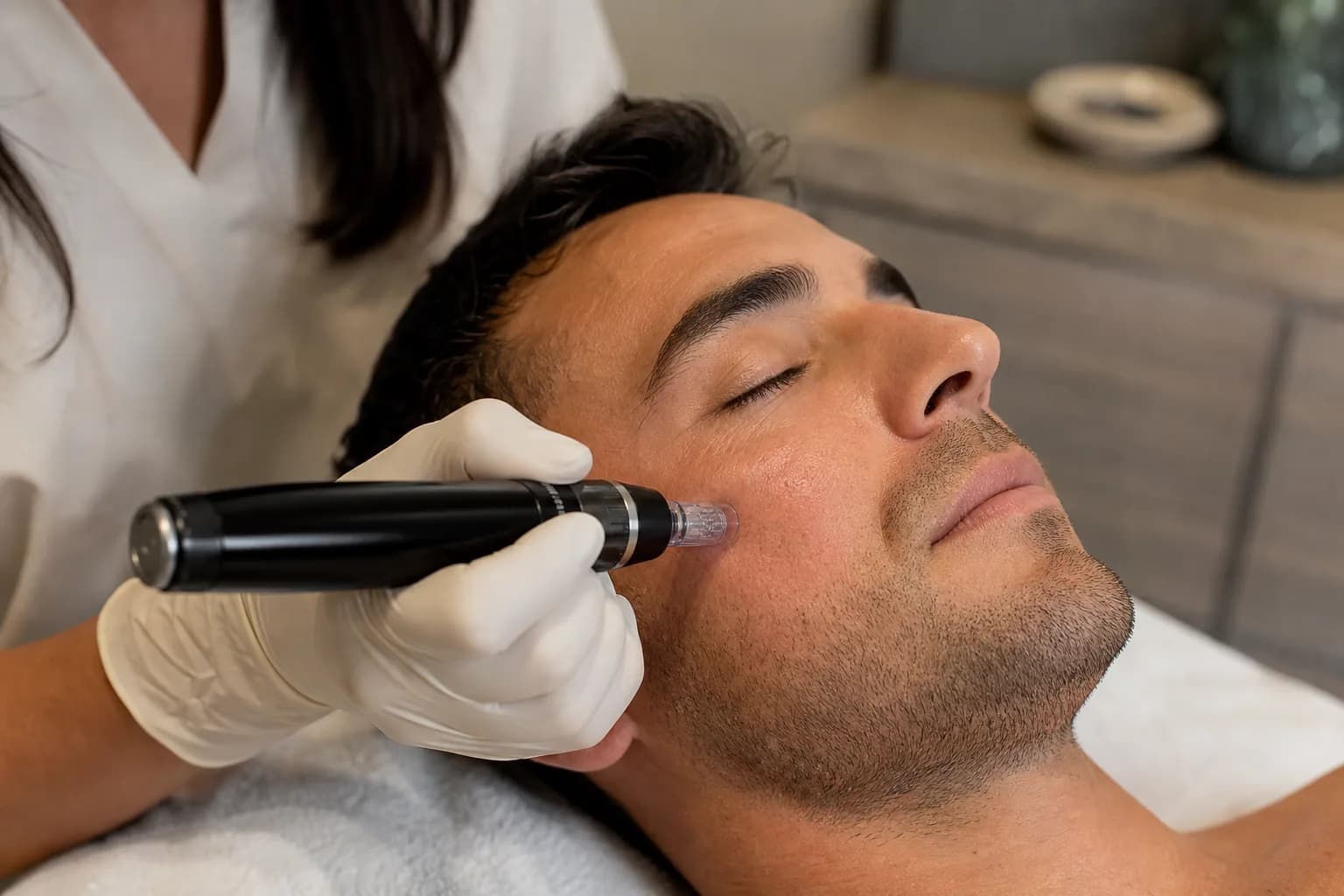
Men's Microneedling in Orange County
Forty-five minutes, one day of looking a little pink, and the pores, scarring and texture that products never touched.
Quick answers
- Microneedling at UR ALLURE in Mission Viejo runs $75 to $280 per session, priced by the area treated and the serum needled in.
- Across nine randomized controlled trials covering 341 participants with atrophic acne scars, improvement appeared as early as the third session.[2]
- The American Academy of Dermatology puts the effect at 3 to 5 sessions every 2 to 4 weeks fading acne scars by 50% to 70%.[3]
- There is no separate men's device or protocol: depth is set by the area of the face, 0.7 to 1.0 mm on the forehead, 0.9 to 1.5 mm on the cheek and 0.5 to 0.8 mm around the eyes.[4]
- A full facial treatment is 15 to 20 minutes of actual needling, and the AAD says you can return to work immediately afterward.[1][3]
- Male skin is measurably thicker, oilier and larger-pored than female skin, which changes which concerns come up rather than whether the treatment works.[6]
What Microneedling Is
Microneedling is collagen induction therapy. A handpiece carrying rows of fine needles makes thousands of controlled punctures to a uniform, preset depth, and the repair response that follows lays down new collagen and elastin.[1] The needles are deliberately short enough to leave most of the epidermis intact, which is why the risk of pigment disturbance is lower than with treatments that ablate the surface.[1] There is no separate men's device, no men's protocol and no men's evidence base — the published trials are not sex-specific. What differs is the skin you arrive with, not the procedure you book.
Why Men Book It
The things men most often want changed — deep post-acne texture, enlarged pores, a rough or orange-peel surface — are structural. They sit in the dermis, several layers below anything a cleanser, an exfoliant or a pore serum can reach, because the stratum corneum is built to keep molecules out and does it indiscriminately.[2] Microneedling is the least expensive procedure that reaches the dermis at all, and it has the shortest recovery of the treatments that do: clinical reference guidance lists short healing time, low cost, good tolerance and minimal pigment risk as its practical advantages.[1] Then there is the calendar. Fifteen to twenty minutes of actual needling, and the AAD says you can go back to work immediately.[1][3]
What Male Skin Brings to It
A review of 57 comparative studies found skin thickness, sebum, hydration, superficial blood flow and pigment all generally higher in men, and found that male skin thickness declines steadily from about age 20 where female skin holds roughly steady until 50 and then drops.[6] Cheek sebum measured 84.17 micrograms per square centimeter in men against 48.66 in a 300-person study, and being male correlates with both larger pores and higher sebum.[6] That is why texture and scarring read more visibly on a man's face. It is not a reason to needle deeper: depth in the published protocols is set by the area being treated and by the concern, not by sex.[4][1]
How It Works
Each puncture triggers the ordinary wound-repair cascade, releasing platelet-derived growth factor, transforming growth factor alpha and beta, connective tissue activating protein, connective tissue growth factor and fibroblast growth factor into the dermis.[1] About five days later a fibronectin matrix forms, and that matrix determines where collagen is laid down; with a 1.5 mm needle, new collagen forms from roughly 600 micrometers upward.[1] Gene expression after treatment shows type I collagen, glycosaminoglycans, VEGF, FGF-7, EGF and TGF-beta all upregulated.[1] Histology after four sessions one month apart shows a 400% increase in collagen and elastin deposition at six months, a thickened stratum spinosum and normal rete ridges at one year.[1]
What It Treats, and What It Does Not
Acne scarring is where the evidence is strongest and most consistent. The FDA has authorized microneedling devices to improve the appearance of facial acne scars, facial wrinkles and abdominal scars in people aged 22 and over.[5] Texture, pores and fine lines follow, on smaller but consistent numbers. What microneedling does not do is replace lost volume, so deep static folds and hollowing stay where they are, and it does not reliably lift ice-pick scars, which are narrow and deep enough to resist needling.[2]
- Rolling and boxcar acne scars — the scar types that respond best across the randomized trials.[2]
- Enlarged pores and rough texture — 83% of subjects in a 48-subject study reported visible improvement in pores after four sessions.[4]
- Fine lines and early wrinkling — mean global wrinkle score improved 1.23 grades by day 150 and texture 1.54 grades in the same study.[4]
- Established post-acne scarring — in a 20-patient prospective study with blinded raters, every scar improved at least 50% after a mean of 2.5 monthly treatments, and 65% improved by more than 75%, holding at 12 months.[8]
- Not tested: razor bumps, ingrown hairs and pseudofolliculitis barbae have never been measured as a microneedling outcome in a controlled trial.[2]
Depth is chosen by area and concern: 1.5 to 2.0 mm for scars, 0.5 to 1.0 mm for aging skin and fine lines, shallower still around the eyes.[1][4]
Who Should Wait
The AAD lists the situations in which microneedling is not appropriate: if you heal slowly or poorly, have or have had a keloid scar, have a weakened immune system from a condition or a medication, are being treated for skin cancer in the area, or are receiving radiation.[3] Treatment is also deferred for a tan or recent sun exposure, an active skin infection, acne that is painful or pustular or deep, and for at least a month after the last isotretinoin pill.[3] A clotting disorder, a course of anticoagulants, uncontrolled diabetes or an active cold sore are all reasons to reschedule rather than push ahead.[5] All of it is covered at consultation before anything is booked.
The Appointment, Step by Step
A short consultation sets the depth and the serum. Numbing cream — lidocaine, usually with prilocaine — goes on under occlusion for 15 to 45 minutes, then comes off with saline before antiseptic is applied.[1] The skin is held taut and the device is passed across it 15 to 20 times in horizontal, vertical and oblique directions, to an endpoint of uniform pinpoint bleeding; that endpoint is the intended result, not a sign anything went wrong.[1] Full-face needling takes 15 to 20 minutes.[1] Saline pads go on afterward, and a little serous drainage in the first hours is a normal part of the earliest stage of wound healing.[1] With numbing in place, pain averaged 5.2 out of 10 in a 48-subject study and 5.4 pooled across a 51-study review.[4][7]
Downtime and Aftercare
There is no true downtime. Redness, mild swelling and light exfoliative scaling last two to three days, and usual activities resume the next day — the AAD's line is that you can return to work immediately.[1][3] The part that decides how well the result holds is sun. Sunscreen goes on with regular reapplication, and sun exposure and harsh chemicals are avoided for at least a week.[1] A skin care routine for two to four weeks beforehand improves the response, which may mean pausing retinoids for a few days and keeping the sun off your face in the run-up.[3]
How Many Sessions, and When Results Show
Three to five sessions every two to four weeks is the AAD's figure for acne scars, and the randomized trials used three to eight sessions at those same intervals.[3][2] A minimum of three weeks between sessions is the published floor.[1] Nothing shows on the day. Visible improvement arrives within a few weeks, and neocollagenesis continues for roughly three to six months after each session, which is why the course keeps working between appointments.[3][1] It holds, too: in the 20-patient prospective study the improvement was still there at 12 months, and histology shows normal rete ridges at a year.[8][1] After a course, the AAD recommends one maintenance session a year.[3]
What It Costs
Microneedling at UR ALLURE runs $75 to $280 per session, set by the area treated and the serum needled in. Face or chest with PDRN is $280 and the neck $140. Exosomes are the same, $280 and $140. Stem-cell conditioned medium is $250 and $125, and a hyaluronic acid, peptide and vitamin cocktail is $150 and $75. Scalp work is a separate service and a separate literature: hairline and temples $240, crown $280, full scalp $400. Because the evidence describes a course of three to five sessions rather than a single visit, the course total is the number that predicts what you will actually spend.[3][2]
Frequently asked questions
What does microneedling do to your face?
It makes thousands of controlled micro-punctures at a preset depth, which sets off the body's wound-repair cascade and lays down new collagen and elastin.[1] Histology after four monthly sessions shows a 400% increase in collagen and elastin deposition at six months, a thickened stratum spinosum and normal rete ridges at one year.[1] Because the epidermis is left largely intact, the risk of pigment disturbance is lower than with treatments that ablate the surface.[1]
Who is microneedling best for?
It suits rolling and boxcar acne scarring, enlarged pores, rough texture and early fine lines best. Across nine randomized controlled trials of atrophic scars covering 341 participants, improvement showed up as early as the third session.[2] It suits ice-pick scarring and volume loss least — those scars are narrow and deep, and needling does not replace lost volume.[2]
Will microneedling help large pores?
Yes, in appearance. In a 48-subject study of four sessions 30 days apart, 83% of subjects reported visible improvement in pores.[4] Pore size tracks sebum, which is measurably higher in male skin.[6] The pore looks smaller; it does not close.
Does microneedling help with acne scars?
Yes, and this is the strongest part of the evidence. The American Academy of Dermatology puts it at 3 to 5 sessions every 2 to 4 weeks fading acne scars by 50% to 70%.[3] In a 20-patient prospective study with blinded raters, every scar improved at least 50% after a mean of 2.5 monthly treatments and 65% improved by more than 75%, still holding at 12 months.[8] Rolling and boxcar scars respond best.[2]
What microneedling depth is used for acne scars?
Scars are treated at 1.5 to 2.0 mm, aging skin and fine lines at 0.5 to 1.0 mm.[1] Across the nine randomized trials of atrophic scars, needle length ran from 0.8 to 3.5 mm.[2] Depth is also set by area — one 48-subject study used 0.7 to 1.0 mm on the forehead, 0.9 to 1.5 mm on the cheek and 0.5 to 0.8 mm around the eyes.[4]
Does microneedling for acne scars hurt?
It scored a mean of 5.2 out of 10 in a 48-subject clinical study, with topical numbing in place.[4] A systematic review of 51 studies covering 1,029 patients put the pooled average at 5.4 for rollers.[7] Numbing cream sits on the skin for 15 to 45 minutes before the first pass, and that is what makes the difference.[1]
How long is microneedling recovery?
Two to three days for the visible part. Redness, mild swelling and light exfoliative scaling last about that long, and usual activities resume the next day.[1] The AAD says you can return to work immediately and advises waiting 24 hours before applying makeup.[3]
How often microneedling can be done
A minimum of three weeks between sessions.[1] The AAD's figure for acne scars is 3 to 5 treatments every 2 to 4 weeks, and the randomized trials used three to eight sessions at two-to-four-week intervals.[3][2] After a course, one maintenance session a year is what the AAD recommends.[3]
Are microneedling results permanent?
The collagen change is durable rather than permanent. Histology shows a 400% increase in collagen and elastin at six months and normal rete ridges at one year, and scar improvement in a 20-patient prospective study was still present at 12 months.[1][8] What it does not do is stop further aging, which is why the AAD recommends a maintenance session once a year.[3]
How much does microneedling cost?
Microneedling at UR ALLURE runs $75 to $280 per session, depending on the area treated and the serum needled in. Face or chest with PDRN or exosomes is $280, stem-cell conditioned medium $250, and a hyaluronic acid and peptide cocktail $150; the neck is half of each. Because the evidence describes a course of three to five sessions, the course total is the figure to plan around.[3]
Is microneedling worth it?
For atrophic acne scarring and texture, the randomized evidence is the argument: nine trials, 341 participants, improvement by the third session.[2] Clinical reference guidance also rates it quick to heal, low in cost and well tolerated relative to other resurfacing.[1] For deep volume loss or ice-pick scarring, a different treatment is the better use of the money.[2]
Why microneedling is bad
The arguments against it come down to technique and to what gets applied through the fresh channels, not to the needling itself. Tram-track scarring — rows of small linear scars caused by too much pressure over bone — was reported in 10.5% of roller-treated patients in one series and 0% with stamps.[7] Post-inflammatory hyperpigmentation reached 13.8% in a case series of Fitzpatrick IV–V patients, which is why deeper skin tones are assessed carefully first.[7][5] A sterile single-use cartridge every session, controlled pressure and a depth matched to the area are what keep those numbers down.
Should microneedling make you bleed?
Uniform pinpoint bleeding is the intended endpoint of the treatment, not a sign that something went wrong — published technique descriptions define it as the point at which to stop working over an area.[1] Saline pads go on straight afterward, and a little serous drainage in the first hours is a normal part of early wound healing.[1]
Sources
- [1] Litchman G, Nair PA, Badri T, Kelly SE. “Microneedling.” StatPearls, NCBI Bookshelf (2022).
- [2] Sitohang IBS, Sirait SAP, Suryanegara J. “Microneedling in the treatment of atrophic scars: A systematic review of randomised controlled trials.” International Wound Journal, 18(5): 577-585 (2021). DOI: 10.1111/iwj.13559
- [3] American Academy of Dermatology. “Microneedling can fade scars, uneven skin tone, and more.” AAD Public Resources, Cosmetic Treatments (2023).
- [4] Journal of Clinical and Aesthetic Dermatology. “Safety and Effectiveness of an Automated Microneedling Device in Improving the Signs of Aging Skin.” Journal of Clinical and Aesthetic Dermatology (2018).
- [5] U.S. Food and Drug Administration. “Microneedling Devices.” FDA Aesthetic (Cosmetic) Devices, product code QAI (2025).
- [6] Rahrovan S, Fanian F, Mehryan P, Humbert P, Firooz A. “Male versus female skin: what dermatologists and cosmeticians should know.” International Journal of Women's Dermatology, 4(3): 122-130 (2018).
- [7] Gowda A, Healey B, Ezaldein H, Merati M. “A Systematic Review Examining the Potential Adverse Effects of Microneedling.” Journal of Clinical and Aesthetic Dermatology, 14(1): 45-54 (2021).
- [8] Alster TS, Li MK. “Microneedling of Scars: A Large Prospective Study with Long-Term Follow-Up.” Plastic and Reconstructive Surgery (2020). DOI: 10.1097/PRS.0000000000006462
Explore Our Treatments
Book Your Microneedling Session
Tell VitaLina what you want changed and she will pick the serum for it. Mission Viejo, private appointments, evenings available.
Book Microneedling