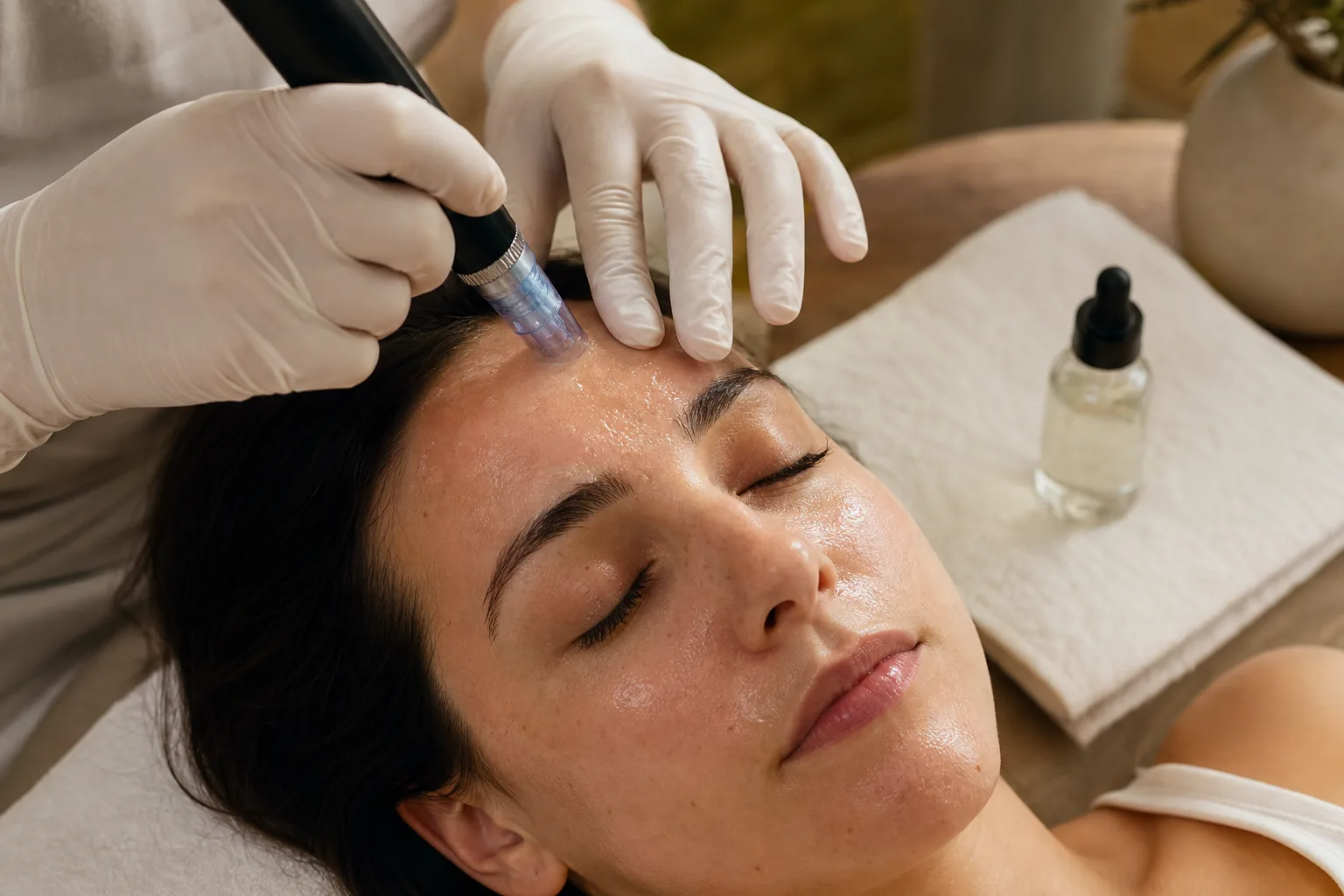
PDRN Microneedling in Orange County
Salmon-DNA PDRN, needled in so it actually reaches the skin that can use it. $280 for the face.
Quick answers
- PDRN microneedling at UR ALLURE in Mission Viejo is $280 for the face or chest and $140 for the neck.
- PDRN is polydeoxyribonucleotide, a mixture of purified DNA fragments taken from salmon; it carries no genetic information and works as a signal rather than a blueprint.[1]
- In the one randomized trial of this exact combination, 24 women received microneedling with 3% salmon PDRN or microneedling with platelet-rich plasma over two sessions three weeks apart, and the PDRN group improved significantly more on the Lemperle wrinkle score (p = 0.021).[2]
- PDRN is defined by molecular weight: binding to the adenosine A2A receptor happens with DNA-derived molecules between roughly 50 and 1,500 kilodaltons.[1]
- The stratum corneum recloses within a maximum of about 15 minutes after needling, so the serum goes on during the session and immediately after it.[8]
- A PDRN session at UR ALLURE runs 30 to 45 minutes including numbing, and most people are pink for 12 to 24 hours.
What PDRN Is
PDRN is polydeoxyribonucleotide: a mixture of purified DNA fragments, most often taken from salmon. It is the same material sold on treatment menus as salmon sperm DNA — one substance, two names. It carries no genetic information and cannot alter yours; it works as a signal, not as a blueprint.[1] It is also a defined substance rather than a marketing word, and the definition is size. Binding to the adenosine A2A receptor happens with DNA-derived molecules between roughly 50 and 1,500 kilodaltons, so a preparation with a stated molecular weight in that band is the one with the mechanism the pharmacology literature describes.[1]
Why Someone Chooses PDRN
PDRN is the repair-and-calm option — the serum for skin that is reactive as well as aging. Plain microneedling is a controlled injury; PDRN's described pharmacology is anti-inflammatory, acting through the adenosine A2A receptor, and that combination is the actual argument for it.[1] It also has the longest run of clinical use of the three serums on the menu: Korean clinics have worked with it for around two decades, and the injected longer-chain relative, polynucleotide, has been through a Phase III randomized trial in 72 patients.[4] If what you want is hydration and glow rather than repair signaling, the hyaluronic acid, peptide and vitamin cocktail at $150 does that job and is the honest answer.
How It Works
Two mechanisms, both described in the pharmacology literature. The first is receptor signaling: PDRN releases nucleotides, nucleosides and nitrogenous bases that bind the adenosine A2A receptor, which influences inflammation, blood-vessel growth and cell division — and blocking that receptor cancels PDRN's effects, which is how the mechanism was established.[1] The second is the salvage pathway, the economical route a cell uses to build DNA when it cannot synthesize it from scratch, as happens under oxidative stress or low oxygen. PDRN supplies the building blocks for it.[1] Both are laboratory findings: they describe what the molecule does, and the clinical measurements sit in the next section.
Why It Has to Be Needled In
A molecule of 50 to 1,500 kilodaltons does not cross intact skin. Microneedling bypasses the stratum corneum and deposits what is applied directly into the vascularized dermis, and it widens the follicular infundibulum by 47%.[3] Applied at home as a serum, PDRN mostly sits on the surface, which is why the two are always done together. Timing matters as well: the stratum corneum recloses within a maximum of about 15 minutes after needling, so the serum goes on during the passes and immediately after them, not later that evening.[8]
What the Trials Measured
The form sold here — PDRN applied through microneedling channels — has one randomized trial behind it. Twenty-four women aged 30 to 50 received either microneedling with 3% salmon PDRN or microneedling with platelet-rich plasma, two sessions three weeks apart, assessed at six weeks; the PDRN group improved significantly more on the Lemperle wrinkle score (p = 0.021), and side effects were minimal and similar in both arms.[2] The injected form has more behind it. Polynucleotide improved elasticity and texture around the eyes more than a hyaluronic acid filler in a randomized double-blind split-face trial of 30 participants.[5] In a Phase III trial of 72 patients given three treatments over 12 weeks, it was non-inferior to a hyaluronic acid filler on crow's feet.[4]
What It Is For, and What It Is Not
PDRN suits skin that is thin, dehydrated, reactive or early in its aging rather than structurally damaged. The trial evidence for the needled form is on wrinkles, and the described pharmacology is repair and anti-inflammatory signaling.[2][1] What it does not do is replace lost volume, so deep static folds stay where they are, and it is not the choice for deep ice-pick scarring, where the needling itself is doing the work and depth matters more than the serum.
- Fine lines and early loss of firmness
- Thin, dehydrated skin that has lost its bounce
- Shallow acne scarring and rough texture
- Large pores — 83% of subjects in a 48-subject microneedling study reported visible improvement in pores after four sessions.[6]
- Reactive skin that does not tolerate aggressive actives
For uneven tone and dark patches, the serum with the relevant pigment trials behind it is stem-cell conditioned medium, $250 for the face or chest. For several concerns at once, exosomes, $280.
The Appointment
Thirty to forty-five minutes, numbing included. Lidocaine-based cream goes on for 15 to 45 minutes and comes off with saline before antiseptic is applied.[3] The skin is held taut and the device is passed across it 15 to 20 times in horizontal, vertical and oblique directions, to an endpoint of uniform pinpoint bleeding — the intended endpoint, not a sign anything went wrong.[3] Full-face needling takes 15 to 20 minutes.[3] The PDRN goes on during the passes and again immediately afterward, while the channels are open, and saline pads follow.[8] With numbing in place, pain averaged 5.2 out of 10 in a 48-subject study.[6]
Downtime and Aftercare
Most people are pink for 12 to 24 hours after a PDRN session. The published microneedling timeline is erythema, mild edema and light exfoliative scaling for two to three days, with usual activities resuming the next day; visible erythema averages about 48 hours, and redness on lighter skin drops by roughly half within 4 to 6 hours.[3][8] Makeup waits 24 hours and work does not.[7] Sunscreen goes on with regular reapplication, and sun and harsh chemicals are avoided for at least a week.[3]
- Hold prescription retinoids, acids and hydroquinone while the skin is still flaking.
- Keep the routine bland — cleanser, a plain ceramide moisturizer, sunscreen.
- Makeup at 24 hours, not before.[7]
- Back to work the same day.[7]
- Mention a fish or shellfish allergy at consultation. PDRN is a fish-derived material, and a product name is not an ingredient list.[1]
Sessions and When Results Show
Nothing shows on the day. The randomized trial of microneedling with PDRN used two sessions three weeks apart and measured at six weeks; the injection trials used three treatments over 12 weeks.[2][4] The plan at the studio is three to six sessions four weeks apart, with texture and hydration usually visible at two to four weeks and firmness, lines and scarring over eight to twelve weeks. Underneath that, new type III collagen is maturing into type I over weeks to months, which is why the result keeps building between appointments and why the course rather than the first session is the thing to judge.[8]
What It Costs
PDRN microneedling is $280 for the face or chest and $140 for the neck. Inside the same service, exosomes are $280 and $140, stem-cell conditioned medium $250 and $125, and a hyaluronic acid, peptide and vitamin cocktail $150 and $75. The needling is identical in every one of them — the price difference is the serum, and PDRN's premium over the cocktail buys receptor-mediated repair signaling rather than more needling.[1] Because the published protocols run to two or three sessions, the course total rather than the single visit is what predicts the spend.[2][4]
Frequently asked questions
Why microneedling with exosomes?
Because a signaling molecule that size cannot cross intact skin on its own. Microneedling bypasses the stratum corneum, deposits what is applied directly into the vascularized dermis and widens the follicular infundibulum by 47%.[3] The same argument applies to PDRN and to stem-cell conditioned medium, which is why all three are needled in rather than sold as creams.
When microneedling, what serum should you use?
The one matched to what you want changed, because the needling is identical in every version. PDRN's described action is anti-inflammatory repair signaling through the adenosine A2A receptor, which is why it is the usual choice for skin that flares easily.[1] Exosomes are chosen when there is more than one concern at once, and conditioned medium when the concern is tone and brightness.
Do microneedling serums work?
Through needling channels they can; from a bottle onto intact skin, largely not. PDRN is defined by its size, a DNA-derived molecule between roughly 50 and 1,500 kilodaltons, which is far more than an intact stratum corneum lets through.[1] Microneedling puts it past that barrier and into the vascularized dermis, which is the whole reason the two are done together.[3]
Which microneedling is best for wrinkles?
On the one head-to-head available, microneedling with 3% salmon PDRN beat microneedling with platelet-rich plasma on the Lemperle wrinkle score in 24 women over six weeks (p = 0.021).[2] Plain microneedling on its own improved global wrinkle score by 1.23 grades at day 150 in a 48-subject study.[6] Injected polynucleotide, the longer-chain relative of PDRN, was non-inferior to a hyaluronic acid filler on crow's feet across 72 patients.[4]
Which microneedling is best for hyperpigmentation?
Not PDRN, on the trials available. The serum with the relevant pigment measurements behind it is stem-cell conditioned medium, which is $250 for the face or chest and $125 for the neck. The needling itself is the same in either version, so the choice is only ever about the serum.
How much does microneedling cost for the face?
PDRN microneedling is $280 for the face or chest and $140 for the neck at UR ALLURE. The same session with a hyaluronic acid, peptide and vitamin cocktail is $150 and $75. Because the published PDRN protocols run to two or three sessions, the course total rather than the single visit is what predicts the spend.[2][4]
How much microneedling do I need?
The microneedling trial of PDRN used two sessions three weeks apart, assessed at six weeks.[2] The injection trials of the related polynucleotide used three treatments over 12 weeks.[4] For microneedling generally, the AAD's figure is 3 to 5 sessions every 2 to 4 weeks.[7] The plan is set at consultation against what you want changed.
Is microneedling worth it for wrinkles?
For wrinkles specifically, a 48-subject study found global wrinkle score improved 1.23 grades by day 150, with 73% of subjects reporting visible improvement in lines and wrinkles.[6] Adding PDRN improved on adding platelet-rich plasma in the one randomized comparison of the two (p = 0.021).[2] These are measured changes built across a course, not a single dramatic result.
Are microneedling results temporary?
The collagen change from the needling is durable: histology shows a 400% increase in collagen and elastin at six months and normal rete ridges at one year.[3] New type III collagen matures into type I over weeks to months, which is why the result keeps improving after the last appointment.[8] The AAD recommends a maintenance session once a year.[7]
Does microneedling hurt?
It scores a mean of around 5 out of 10 with topical numbing in place — 5.2 in a 48-subject clinical study.[6] Numbing cream sits on the skin for 15 to 45 minutes before the first pass.[3] In the randomized PDRN comparison, side effects were described as minimal and similar in both arms.[2]
How long does microneedling redness last?
Two to three days for erythema, mild swelling and light flaking.[3] Visible erythema averages about 48 hours, and redness on lighter skin drops by roughly half within 4 to 6 hours.[8] After a PDRN session at the studio, most people are pink for 12 to 24 hours.
Is microneedling good for your skin?
For texture, fine lines and atrophic acne scarring, yes. Clinical reference guidance rates it quick to heal, low in cost, well tolerated, and lower-risk for pigment change than treatments that ablate the epidermis.[3] The repair response it triggers is the same one the body uses for any wound, directed at a controlled depth.[3] What it does not do is replace volume, so deep static folds need something else.
Sources
- [1] Arora G, Arora S. “Polynucleotides and polydeoxyribonucleotides in dermatology — A narrative review.” Journal of Cutaneous and Aesthetic Surgery (2025).
- [2] Yulita M, et al.. “Comparison of microneedling and polydeoxyribonucleotide salmon 3% versus microneedling and platelet rich plasma in treating wrinkles and facial hyperpigmentation.” Aesthetic Medicine (2025).
- [3] Litchman G, Nair PA, Badri T, Kelly SE. “Microneedling.” StatPearls, NCBI Bookshelf (2022).
- [4] Pak CS, Lee YK, Jeong JH, et al.. “Safety and efficacy of ultrapure polynucleotide (PRM-001) filler: a Phase III, randomized, double-blind, matched-pairs clinical trial.” Journal of Korean Medical Science, 29(Suppl 3): S201-S209 (2014).
- [5] Lee YJ, Kim HT, Lee YJ, et al.. “Comparison of the effects of polynucleotide and hyaluronic acid fillers on periocular rejuvenation: a randomized, double-blind, split-face trial.” Journal of Dermatological Treatment, 33(1): 254-260 (2022). DOI: 10.1080/09546634.2020.1748857
- [6] Journal of Clinical and Aesthetic Dermatology. “Safety and Effectiveness of an Automated Microneedling Device in Improving the Signs of Aging Skin.” Journal of Clinical and Aesthetic Dermatology (2018).
- [7] American Academy of Dermatology. “Microneedling can fade scars, uneven skin tone, and more.” AAD Public Resources, Cosmetic Treatments (2023).
- [8] Liebl H, Kloth LC. “Skin Cell Proliferation Stimulated by Microneedles.” Journal of the American College of Clinical Wound Specialists, 4(1): 2-6 (2012). DOI: 10.1016/j.jccw.2012.11.001
Explore Our Treatments
Book PDRN Microneedling
Book with VitaLina in Mission Viejo. She will tell you whether PDRN or one of the other serums is the right fit for your skin.
Book PDRN Microneedling