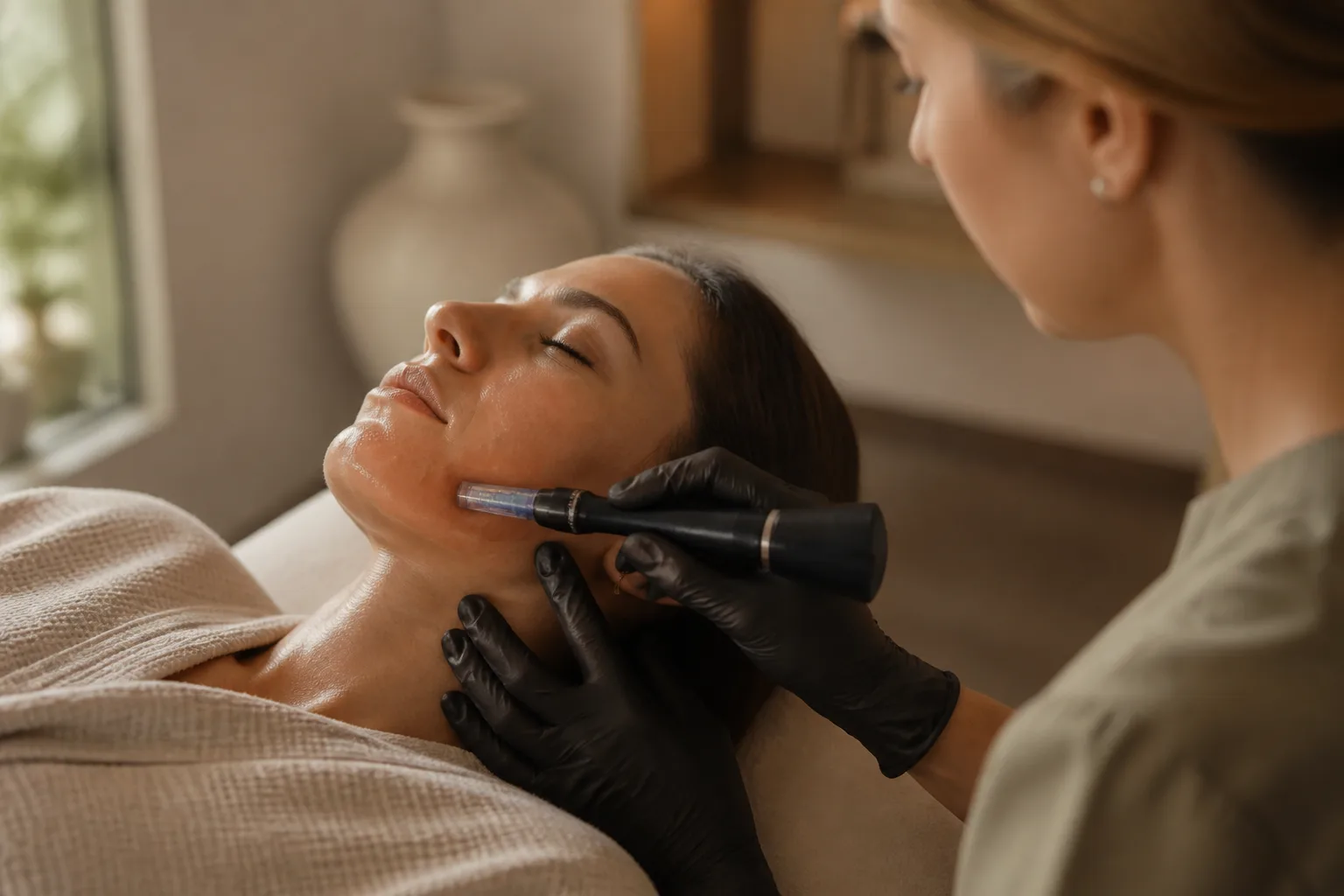
Stem Cell Microneedling in Orange County
Growth-factor serum, needled in. The middle option of the three, at $250 for the face.
Quick answers
- Stem cell microneedling at UR ALLURE in Mission Viejo is $250 for the face or chest and $125 for the neck.
- No stem cells are put into your skin: what goes on is conditioned medium, also called the secretome, which is the liquid the cells were grown in with the cells themselves filtered out.[1]
- In a randomized blinded split-face trial of 25 women, the melanin index fell from 138 to 113 on the conditioned-medium side against 143 to 136 on the saline side (p < 0.05).[1]
- In a double-blind trial of 57 women aged 35 to 59, four-fold concentrated secretome reduced spots at week 4 and UV spots at week 8 against control, while the unconcentrated preparation did not separate from saline.[3]
- All three published conditioned-medium trials used five sessions at two-week intervals.[1][2][3]
- An exosome serum is the isolated vesicles; a stem cell serum is the whole culture broth they came in.[7]
What Is Actually Applied
No stem cells are put into your skin. What goes on is conditioned medium — also called the secretome: the liquid the stem cells were grown in, holding the growth factors and signaling proteins they released, with the cells themselves filtered out.[1] That is not a euphemism invented by marketers. It is the standard wording of the trials themselves, which describe human stem cell conditioned medium, mesenchymal stem cell conditioned media and secretome.[1][2][3] The cells matter only as the factory. What you are buying is what they made.
Where the Material Comes From
Published trials have used medium from human embryonic stem cell-derived endothelial precursor cells, umbilical cord mesenchymal stem cells, adipose-derived mesenchymal stem cells and amniotic membrane stem cells.[1][2][3] Those produce different mixtures, which is why concentration rather than the label on the bottle is the question worth asking — and the trials are clear that concentration is what moved the results.
Stem cell and exosome are not clean opposites. A conditioned medium contains exosomes among its other contents, and several products sold as exosomes are explicitly stem-cell-derived.[7] An exosome serum is the isolated vesicles; a stem cell serum is the whole broth they came in.
Why Someone Chooses It
It is the tone-and-brightness option. In two randomized, blinded, split-face trials, the measurable extra effect of conditioned medium over needling alone was strongest on pigment — melanin index, brightness, texture and UV spots.[1][2] The trial design behind it is also the cleanest in this family: conditioned medium plus needling on one side of the face against saline plus needling on the other, with participants and both assessing dermatologists blinded, so the only variable between the two halves is the serum.[1] And it is the least expensive of the three serums, $250 for the face or chest against $280 for PDRN or exosomes.
How It Works
Stem cells are grown in culture, and the liquid they grow in accumulates the growth factors and signaling proteins they release; the cells are filtered out and the liquid is the product.[1] On intact skin most of it goes nowhere, because growth factors are typically above 20,000 daltons against a barrier that stops hydrophilic molecules much above 500 daltons — which is the physical reason a growth-factor cream costs a lot and does comparatively little.[1] Microneedling bypasses the stratum corneum and deposits the medium directly into the vascularized dermis, widening the follicular infundibulum by 47%.[4] The needling independently triggers the collagen cascade, so what the trials report for the serum is the extra effect on top of a wound that was going to do work anyway.[4][1]
What the Trials Measured
Three trials carry this treatment, and all three used the same protocol: five sessions at two-week intervals. Two of them were blinded split-face designs, which means the same face carried both the serum side and the saline side and neither the participant nor the assessing dermatologist knew which was which.[1][2] The needle depth in the earliest of them was a 0.25 mm roller — considerably shallower than the 0.8 to 3.5 mm used in acne-scar microneedling, which is consistent with the target being pigment and brightness rather than scar depth.[1]
- 25 women, randomized blinded split-face, five sessions two weeks apart: physician-graded pigment and wrinkles both improved more on the conditioned-medium side (p < 0.05), and the melanin index fell from 138 to 113 there against 143 to 136 on the control side.[1]
- 30 volunteers, randomized split-face with umbilical cord mesenchymal stem cell conditioned medium, five sessions two weeks apart: investigator-assessed brightness and texture, self-rated satisfaction, melanin index and UV spots all favored the treated side.[2]
- 57 women aged 35 to 59, double-blind: four-fold concentrated adipose-derived secretome reduced spots at week 4 (p = 0.031), UV spots at week 8 (p = 0.035) and porphyrins at weeks 6 and 8 (p = 0.007 and p = 0.019) against control.[3]
- The same trial found the unconcentrated preparation did not separate from saline on any measure, which is the clearest evidence in this category that concentration decides the result.[3]
- The only side effect recorded across the 25-woman trial was mild flaking in one participant, and no severe side effects were recorded across the 30-volunteer trial.[1][2]
What It Treats, and What It Does Not
This is the serum to pick when the complaint is how the skin looks rather than how it is shaped: dullness, uneven tone, dark patches, a surface that has lost its brightness. Firmness, fine lines, early creping, texture and pore size sit alongside it.[1][2] What it does not do is replace volume, and it is not the first choice for deep acne scarring — that is where the needling itself carries the evidence, and depth and session count matter more than which serum goes on.[4]
- Uneven tone, dullness and dark patches
- Firmness and elasticity
- Fine lines and early creping
- Texture and pore size — texture improved 1.54 grades by day 150 in a 48-subject microneedling study.[5]
- Sun damage and UV spots on a face that has had years of it.[3]
Concentration is the thing to ask about. A product name is not an ingredient list, and one trial found the difference from saline disappeared when the preparation was not concentrated.[3]
The Appointment
Forty-five to sixty minutes, numbing included. Lidocaine-based cream goes on for 15 to 45 minutes and comes off with saline before antiseptic is applied.[4] The skin is held taut and the device is passed across it 15 to 20 times in horizontal, vertical and oblique directions, to an endpoint of uniform pinpoint bleeding — the intended endpoint, not a sign that anything went wrong.[4] Full-face needling takes 15 to 20 minutes.[4] The medium goes on during the passes and again immediately afterward, while the channels are open. With numbing in place, pain averaged 5.2 out of 10 in a 48-subject study.[5]
Downtime and Aftercare
Pink for a day. The published timeline for the needling is erythema, mild edema and light exfoliative scaling for two to three days, with usual activities resuming the next day; makeup waits 24 hours and work does not.[4][6] Sun protection is this treatment's own logic rather than a generic instruction — if the reason for choosing this serum is tone, then broad-spectrum sunscreen, reapplied, is what protects the result.[4] Hold hydroquinone, prescription retinoids and acids while the skin is still flaking. They are exactly the products a pigment-focused routine is built on, and they wait for the barrier to close.
Sessions and When Results Show
Five sessions at two-week intervals is the protocol in all three published trials, and the plan at the studio is three to six sessions four weeks apart, set at consultation against what you want changed.[1][2][3] Measurable change on spots appeared by week 4 and on UV spots by week 8 in the concentrated-secretome trial.[3] The needling's own contribution runs longer: neocollagenesis continues for roughly three to six months after each session, and the AAD recommends a maintenance session once a year.[4][6]
What It Costs
Stem cell microneedling is $250 for the face or chest and $125 for the neck. Inside the same service, PDRN is $280 and $140, exosomes are $280 and $140, and a hyaluronic acid, peptide and vitamin cocktail is $150 and $75. The needling is identical in all of them — you are choosing the serum, not the procedure. Because the published trials ran five sessions at two-week intervals, the course rather than the single visit is the right unit for comparing what a treatment plan actually costs.[1][2][3]
Frequently asked questions
When microneedling, what serum should you use?
The one matched to the concern, because the needling is identical in every version. Conditioned medium — what the menu calls stem cell — has two randomized blinded split-face trials behind it, and in both the measurable extra effect over needling alone was strongest on pigment and brightness.[1][2] No trial has compared the three serums head to head, so the choice is made on what each has been tested for.
Do microneedling serums work?
Through needling channels they can, and concentration decides it. In a double-blind randomized trial of 57 women aged 35 to 59, four-fold concentrated adipose-derived secretome reduced spots by week 4 (p = 0.031) and UV spots by week 8 (p = 0.035) against control.[3] The unconcentrated preparation did not separate from saline, which is why the strength of the product matters as much as the name on it.[3]
Do microneedling creams work?
Applied to intact skin, largely not, for a physical reason: hydrophilic molecules much above 500 daltons barely cross the stratum corneum, and most growth factors are above 20,000 daltons.[1] That is why every trial in this literature pairs the medium with needling rather than testing it as a cream.[1][2]
Which microneedling is best for hyperpigmentation?
On the available trials, conditioned medium. In a blinded split-face study of 25 women, the melanin index fell from 138 to 113 on the treated side against 143 to 136 on the needling-only side (p < 0.05).[1] A second randomized split-face trial in 30 volunteers found melanin index and UV spots both favoring the conditioned-medium side.[2] Both used five sessions two weeks apart.
Will microneedling help with dark spots?
In the concentrated-secretome trial, spots fell against control by week 4 and UV spots by week 8.[3] In the two blinded split-face trials, the melanin index moved on the treated side and not on the control side.[1][2] Sun protection afterward is part of the treatment rather than an afterthought.
Can microneedling help with hyperpigmentation?
Yes, on several measures and in more than one literature. Conditioned medium moved the melanin index in two blinded split-face trials, and stem-cell-derived exosomes with microneedling cut pigmentation 9.9% against 1% on the control side of a 28-person split-face trial (p = 0.044).[1][2][7] Depth and interval are set conservatively in deeper skin tones, where microneedling carries a pigment risk of its own.
Does microneedling help with sun spots?
The most direct measurement available is a double-blind trial of 57 women in which four-fold concentrated secretome with microneedling reduced UV spots against control at week 8 (p = 0.035).[3] Porphyrins also fell at weeks 6 and 8 (p = 0.007 and p = 0.019).[3] The unconcentrated arm did not move on any measure.[3]
Does microneedling tighten skin?
Physician-graded wrinkle scores improved more on the conditioned-medium side than on the needling-only side in a blinded split-face trial, and instrument wrinkle measures moved on the treated side and not on the control side.[1] For microneedling alone, a 48-subject study found skin laxity improved but only reached statistical significance at day 150.[5] It firms; it does not lift.
How much microneedling do you need to see results?
All three conditioned-medium trials used five sessions at two-week intervals, with measurable change on spots by week 4 and on UV spots by week 8.[1][2][3] For the needling itself, the AAD's figure is 3 to 5 sessions every 2 to 4 weeks, and neocollagenesis continues for three to six months after each one.[6][4]
How much does microneedling cost for the face?
Stem cell microneedling is $250 for the face or chest and $125 for the neck at UR ALLURE, against $280 for PDRN or exosomes and $150 for a hyaluronic acid and peptide cocktail. Because the trials ran five sessions at two-week intervals, the course rather than the single visit is the right comparison.[1][2][3]
Are microneedling results permanent?
The needling's collagen change is durable: histology shows a 400% increase in collagen and elastin at six months and normal rete ridges at one year.[4] For the serum half, both blinded split-face trials measured two weeks after the fifth session, so the published window is the course itself.[1][2] The AAD recommends a maintenance session once a year.[6]
How can I improve skin texture?
Microneedling is the intervention with the most randomized evidence behind it for texture: texture improved 1.54 grades by day 150 in a 48-subject study, with 73% of subjects reporting visible improvement in lines and wrinkles.[5] In the conditioned-medium trials, investigator-assessed brightness and texture both favored the treated side over needling alone.[2] A course rather than a single session is what moves it.
Sources
- [1] Lee HJ, Lee EG, Kang S, Sung JH, Chung HM, Kim DH. “Efficacy of microneedling plus human stem cell conditioned medium for skin rejuvenation: a randomized, controlled, blinded split-face study.” Annals of Dermatology, 26(5): 584-591 (2014). DOI: 10.5021/ad.2014.26.5.584
- [2] Liang X, Li J, Yan Y, et al.. “Efficacy of microneedling combined with local application of human umbilical cord-derived mesenchymal stem cells conditioned media in skin brightness and rejuvenation: a randomized controlled split-face study.” Frontiers in Medicine, 9: 837332 (2022). DOI: 10.3389/fmed.2022.837332
- [3] Suseno LS, Japranata VV, Legiawati L, et al.. “Microneedling combined with concentrated adipose-derived mesenchymal stem cells secretome alleviate facial skin aging features: a double-blind, randomized controlled trial.” Journal of Cutaneous and Aesthetic Surgery (2025). DOI: 10.25259/jcas_78_2025
- [4] Litchman G, Nair PA, Badri T, Kelly SE. “Microneedling.” StatPearls, NCBI Bookshelf (2022).
- [5] Journal of Clinical and Aesthetic Dermatology. “Safety and Effectiveness of an Automated Microneedling Device in Improving the Signs of Aging Skin.” Journal of Clinical and Aesthetic Dermatology (2018).
- [6] American Academy of Dermatology. “Microneedling can fade scars, uneven skin tone, and more.” AAD Public Resources, Cosmetic Treatments (2023).
- [7] Dhaliwal NK, Moothathamby T, Sokhal BS, Gkini MA. “The Use of Microneedling With Exosomes in Dermatology: A Systematic Review.” Journal of Cosmetic Dermatology, 25: e70881 (2026). DOI: 10.1111/jocd.70881
Explore Our Treatments
Book Stem Cell Microneedling
Book with VitaLina in Mission Viejo. Bring your current routine and she will tell you which serum is worth your money.
Book Stem Cell Microneedling