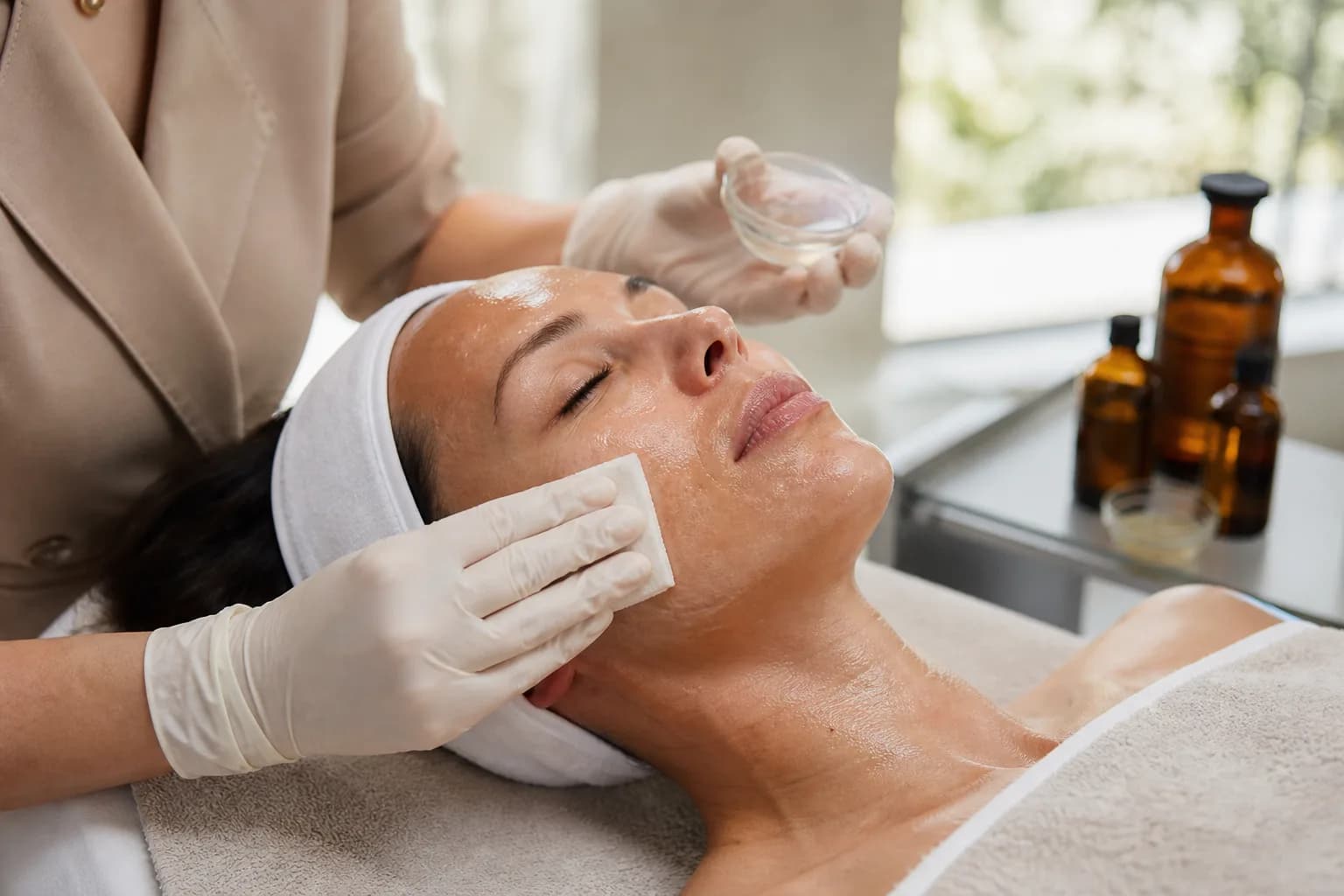
Professional Chemical Peels in Orange County: Glymed+ and Lira
$100 for a peel at clinical strength — the concentrations a shop is not allowed to sell you.
Quick answers
- A professional chemical peel at UR ALLURE in Mission Viejo is $100 for the face, the neck or the chest, using a Glymed+, Lira or comparable professional formulation.
- Consumer acid products are formulated at 10% or less at a final pH of 3.5 or above; salon-strength products run to 30% at a final pH of 3.0 or above [1].
- pKa is the pH at which half a solution sits in free-acid form, so a lower pKa means a stronger peel: glycolic acid is 3.83 and trichloroacetic acid is 0.26 [2].
- In the only placebo-controlled trial in a systematic review of peels for acne, 40% glycolic acid produced excellent or good improvement in 92% of split faces against 40% for placebo [5].
- In a randomized melasma trial, six peels over twelve weeks cut severity scores by 79% with glycolic acid and 73% with TCA, with no significant difference between them [6].
- Across 473 superficial peel treatments in Fitzpatrick types III to VI, 3.8% were associated with any complication and every side effect resolved [7].
Why Your Shop-Bought Peel Does So Little
Over-the-counter acids are capped, and the cap is written into the guidance. The Cosmetic Ingredient Review Expert Panel, quoted in FDA guidance, concluded that glycolic and lactic acid are safe in cosmetic products at concentrations of 10% or less at a final formulation pH of 3.5 or above — and separately safe in salon products at 30% or less at a final pH of 3.0 or above, when applied by trained professionals [1]. That is a three-fold difference in concentration and a lower pH at the same time. A professional peel is formulated to sit outside the consumer limits on purpose, which is exactly why it is timed, watched and, for some agents, neutralized rather than left to sit.
Why Someone Books a Clinical Peel
Because pH is the half of the equation nobody talks about, and it is the half that decides what the number on a label actually does. pKa is the pH at which half a solution is in free-acid form, and a low pKa means greater availability of free acid and therefore a stronger peel [2]. Glycolic acid's pKa is 3.83; trichloroacetic acid's is 0.26 [2]. A 30% acid at pH 3.8 and a 30% acid at pH 2.0 are different procedures wearing the same label. The second reason is that this peel is chosen rather than fixed — the line and the strength are selected after your skin is looked at, and for reactive or pigment-prone skin that choice is the product.
The Two Lines VitaLina Works From
Both are professional lines rather than retail products. GlyMed+ builds its peels on pharmaceutical-grade glycolic, lactic and mandelic acids with TCA; its 5-Berry formula uses licorice root for pigmentation and is gentle enough for deeper skin tones. Lira Clinical pairs its acids with plant stem cells, so the skin is being calmed while it is being corrected — that is the line for skin that reacts to everything. Which one goes on, at what strength and for how long, is decided at the appointment. A third professional formulation is used where neither fits.
How a Peel Works Under the Surface
The acids cause controlled keratocoagulation and denaturation of the proteins within the epidermis and dermis, releasing the proinflammatory cytokines and chemokines that start repair [3]. That signal drives an ordinary wound-healing process, which the peel literature describes in four phases — inflammation, coagulation, re-epithelialization and fibroplasia [2]. New collagen and elastin form and new keratinocytes regenerate, resulting in rejuvenation and thickening of the epidermis and an increase in dermal volume [3]. Epidermal regeneration is generally complete within three to five days, with re-epithelialization complete within seven to ten [3]. Neutralizing is part of the craft: glycolic acid is the prototypical non-self-neutralizing AHA, so it is timed, watched and then stopped, while salicylic acid is self-neutralized by the skin's own lipoproteins [3].
Neutralizing an acid with a base is exothermic, so a brief rise in warmth, burning or stinging is likely during that step [3]. Knowing it is coming is the difference between an alarming moment and an ordinary one.
The Acids, and What Each One Is For
There is no single best peel, only the right acid for the concern in front of it. These are the superficial-strength ranges the literature uses, and what each agent is chosen to do. The white film people sometimes see on a salicylic peel is not frosting — it is the acid crystallizing as the ethanol evaporates, and it is self-limiting [2].
- Glycolic acid — the smallest AHA, water-soluble, used at 30–50% and the most commonly used agent for melasma and diffuse pigmentation [3]
- Lactic acid — used at 10–30%, with a lower pKa and therefore a lower pH than glycolic acid at equivalent concentrations [3]
- Mandelic acid — a larger AHA used around 40%, penetrating slowly and uniformly, re-epithelializing in three to five days [3]
- Salicylic acid — a BHA used at 10–30%, oil-soluble so it reaches inside the follicle, and more accurately desmolytic than keratolytic [4]
- Trichloroacetic acid — a protein denaturant, superficial at 10–30% and medium-depth at 35–50% [2]
- Jessner's solution — resorcinol and salicylic acid with lactic acid in ethanol, used for superficial peeling or to prime the skin [3]
What It Treats, With the Numbers
Pigment has the strongest evidence. In a randomized trial of 40 women with epidermal or mixed melasma, peels every fifteen days cut melasma severity scores by 79% with 20–35% glycolic acid and 73% with 10–20% TCA [6]. Epidermal melasma responded far better than mixed — 79% against 48% [6]. For active acne, the only placebo-controlled trial in the systematic review was a split-face study of 40% glycolic acid in 25 patients: 92% excellent or good improvement on the peel side against 40% on placebo [5]. In the same review, a 20% salicylic–10% mandelic peel beat a 35% glycolic peel on total acne score, 85.3% against 68.5% [5].
- Breakouts and congestion — salicylic acid clears the plug inside the pore [4]
- Post-acne marks left behind after the spot has gone
- Melasma, sun damage and pigmentation, with mandelic acid where rebound pigment is a risk
- Fine lines around the eyes and mouth
- Dull, rough skin that has stopped responding to your products
What a Peel Does Not Reach
Deep scars, deep wrinkles and sagging skin. A peel cannot remove deep scars or wrinkles or tighten sagging skin [8], and deep rhytides, laxity of the jowls and actual ptosis are unlikely to respond regardless of treatment depth [3]. Depth is also the ceiling on pigment: superficial and medium peels are not effective for dermal melasma [6]. Results are real without being permanent — over time, age and new sun damage bring new lines and new color changes [8]. In the melasma trial, relapse occurred in 2 of 20 patients in the glycolic arm at six months, while the rest held their result past a year with sunscreen [6].
When a Peel Is Not the Right Move Right Now
Absolute contraindications to peeling are an active bacterial, viral or fungal infection, a known allergy to a peeling ingredient, open wounds and pregnancy [2]. Inflammatory skin conditions — rosacea, atopic dermatitis, psoriasis — are relative rather than absolute: they are treated with more caution and with a formulation chosen for them, which is precisely what the Lira line exists for [2]. Skin already primed by daily acids, a retinoid or a scrub habit is its own case, because cutaneous priming is one of the listed variables that pushes a peel deeper than intended [2]. Waxing, electrolysis and dermabrasion are avoided for three to four weeks beforehand [2].
The Appointment and the Days After
About forty minutes: ten for the skin assessment and the choice of formulation, five to cleanse and degrease, fifteen to twenty with the solution on the skin in controlled layers, then neutralizing, a calming finish and SPF. This is the peel in the family that does flake, and that is worth saying plainly, because anyone choosing between this and BioRePeel CL3 is choosing on exactly that. The published baseline is redness for one to seven days with scaling for three to seven days after [8]. Makeup usually goes back on immediately or the next day after a light peel [8]. Brightening shows within three to seven days as the treated cells clear.
Sessions, Results and What It Costs
Three to six peels a month apart, each tending to work better than the last. The published figure for superficial peels is three to five treatments, every two to five weeks [8]. Sun protection is part of the treatment: repeated AHA use lowers the skin's UV threshold, with an average 13% reduction in minimal erythema dose recorded by the CIR panel and some individuals at 50%, and glycolic acid as low as 4% over as little as four days can alter the skin's response to UV [1]. The studio protocol is SPF 30 in winter and SPF 50 in summer, every morning. A professional peel is $100 for the face, the neck or the chest; BioRePeel CL3 is $140.
One peel a month for three months beats a year of exfoliating at home.
Frequently asked questions
How chemical peel works?
A controlled acid solution causes keratocoagulation and denaturation of proteins in the epidermis and dermis, releasing the cytokines that start repair [3]. New collagen and elastin form and new keratinocytes regenerate, producing thickening of the epidermis and an increase in dermal volume [3]. On histology: a thinner stratum corneum and more even melanin [2].
Do chemical peels actually work?
Yes, and the cleanest evidence is placebo-controlled. In a split-face trial of 40% glycolic acid in 25 patients, 92% showed excellent or good improvement on the peel side against 40% on the placebo side [5]. For melasma, six peels over twelve weeks cut severity scores by 79% with glycolic acid and 73% with TCA [6].
What chemical peel do dermatologist use?
The same acid families used here — glycolic, lactic, mandelic, salicylic, trichloroacetic acid and Jessner's solution — chosen by concern rather than by brand [3]. What separates settings is strength and pH: consumer products are formulated at 10% or less at pH 3.5 or above, salon products at up to 30% at pH 3.0 or above [1].
Which chemical peel is most effective?
None is universally most effective — the acid is matched to the concern. Glycolic acid is the most commonly used agent for melasma and diffuse pigmentation [3]. Salicylic acid is the choice for comedonal congestion because it is oil-soluble and reaches inside the follicle [4]. Mandelic acid penetrates slowly and uniformly, which suits sensitive skin [3].
What chemical peel should I get?
The one matched to what you want changed, chosen after your skin has been looked at. Pigment and dullness point toward glycolic acid; breakouts and congestion toward salicylic; reactive skin toward mandelic acid or the Lira line. At $100 for face, neck or chest, the formulation is decided at the appointment rather than picked from a menu.
How much chemical peel cost?
$100 for the face, the neck or the chest at UR ALLURE in Mission Viejo, for a Glymed+, Lira or comparable professional formulation. BioRePeel CL3, the other variant of the same service, is $140. An LED add-on is $1 per minute, and there is no fixed course price.
How long chemical peel results last?
Months, and after that it depends largely on sun. Results are not permanent: over time, age and new sun damage bring new lines and new color changes [8]. In the melasma trial, most patients held their result past a year with regular sunscreen use [6].
How often chemical peel should be done?
Every two to five weeks during a course, which is the published interval for superficial peels [8]. At UR ALLURE the usual plan is three to six peels a month apart, each tending to work better than the last. Afterwards, a single peel occasionally holds the result.
Which chemical peel is best for hyperpigmentation?
Glycolic acid has the most evidence behind it — the most commonly used agent for melasma and diffuse pigmentation [3], and 20–35% glycolic acid cut melasma severity scores by 79% in a randomized trial [6]. For post-acne pigment, a 20% salicylic–10% mandelic combination outperformed 35% glycolic acid across the board [5].
Which chemical peel is best for melasma?
Glycolic acid by weight of evidence, with TCA close behind: 79% and 73% reductions in melasma severity across six peels in twelve weeks, with no significant difference between the arms [6]. Depth is the limit — superficial and medium peels are not effective for dermal melasma [6].
Can chemical peels make melasma worse?
It can go that way, and the mechanism is post-inflammatory hyperpigmentation rather than the peel itself. Too much depth, or sun on freshly treated skin, is the route to a worse outcome; conservative depth and strict sun protection are the route to a better one [2]. Relapse in the melasma trial was 2 of 20 at six months [6].
Which chemical peel is best for acne?
Salicylic acid and salicylic–mandelic combinations. In a 40-patient trial, a 20% salicylic–10% mandelic peel beat a 35% glycolic peel on comedones, 90.2% against 35.9%, and on total acne score, 85.3% against 68.5% [5]. Salicylic acid is oil-soluble, so it reaches into the follicle where the plug forms [4].
Will chemical peel remove sun spots?
They lighten sun-induced pigment and even out tone — a superficial peel produces a more even distribution of melanin on histology [2], and pigment is where the peel trials are strongest, at 79% and 73% reductions in melasma severity [6]. What a peel does not do is tighten sun-slackened skin or fill deep lines [2].
How long chemical peel recovery?
Three to seven days at this strength. The published baseline is redness for one to seven days with scaling for three to seven days after [8], and epidermal regeneration is generally complete within three to five days, with re-epithelialization complete within seven to ten [3]. Makeup usually goes back on immediately or the next day [8].
Sources
- [1] US Food and Drug Administration. “Guidance for Industry: Labeling for Cosmetics Containing Alpha Hydroxy Acids.” fda.gov, Docket FDA-2000-P-0063 (2005).
- [2] O'Connor AA, Lowe PM, Shumack S, Lim AC. “Chemical peels: A review of current practice.” Australasian Journal of Dermatology, 59(3): 171-181 (2018). DOI: 10.1111/ajd.12715
- [3] Soleymani T, Lanoue J, Rahman Z. “A Practical Approach to Chemical Peels: A Review of Fundamentals and Step-by-step Algorithmic Protocol for Treatment.” Journal of Clinical and Aesthetic Dermatology, 11(8): 21-28 (2018).
- [4] Arif T. “Salicylic acid as a peeling agent: a comprehensive review.” Clinical, Cosmetic and Investigational Dermatology, 8: 455-461 (2015). DOI: 10.2147/CCID.S84765
- [5] Chen X, Wang S, Yang M, Li L. “Chemical peels for acne vulgaris: a systematic review of randomised controlled trials.” BMJ Open (2018).
- [6] Kumari R, Thappa DM. “Comparative study of trichloroacetic acid versus glycolic acid chemical peels in the treatment of melasma.” Indian Journal of Dermatology, Venereology and Leprology (2010).
- [7] Vemula S, Maymone MBC, Secemsky EA, et al.. “Assessing the safety of superficial chemical peels in darker skin: A retrospective study.” Journal of the American Academy of Dermatology, 79: 508-513.e2 (2018).
- [8] American Academy of Dermatology. “Chemical peels: FAQs.” aad.org (2024).
Explore Our Treatments
Book a Peel
Book with VitaLina in Mission Viejo. She will assess your skin, choose the formulation, and tell you what it will and will not fix.
Book Your Peel